

Specialist orthopaedic care from Dr Luren Reddy, advanced joint replacement
surgery using MAKO SmartRobotics™ at Life Entabeni Hospital, Berea.
Dr Luren Reddy is a specialist orthopaedic surgeon based in Durban with over two decades of experience. Trained at the University of KwaZulu-Natal and Nelson Mandela School of Medicine, Dr Reddy has been in private practice since 2013 as part of the established Drs Beekarun, Moodley, Rajah & Partners practice.
Hip and knee replacement surgery is a core area of Dr Reddy’s practice. He performs these procedures using the MAKO SmartRobotics™ system one of the most advanced surgical technologies available for joint replacement today.
Joint replacement surgery is one of the most commonly performed and successful orthopaedic procedures in the world. For patients living with chronic joint pain that has not responded to conservative treatment, it can offer significant pain relief and a meaningful improvement in quality of life.
If you are experiencing hip or knee pain that is limiting your daily life, a consultation with Dr Reddy is the right first step.
In most cases, hip and knee replacement surgery is considered when joint pain becomes severe enough to affect daily function and when non-surgical treatments, such as physiotherapy, anti-inflammatory medication, or injections, have not provided adequate or lasting relief.
These conditions cause the joint surfaces to break down over time. When the cartilage that cushions the joint is lost, bone rubs on bone, causing pain, stiffness, and reduced mobility. The decision to proceed with surgery is always made in consultation with Dr Reddy, based on a thorough assessment of your condition, imaging, and what matters most to you. There is no pressure; your consultation is an opportunity to understand your options.
Both procedures are performed under anaesthesia and are followed by a period of rehabilitation. Most patients begin mobilising with assistance shortly after surgery, with physiotherapy playing an important role in recovery.
Hip and knee replacement surgery, also known as arthroplasty, involves removing the damaged surfaces of a joint and replacing them with prosthetic components designed to replicate natural joint function. The goal is to relieve pain, restore mobility, and improve quality of life.
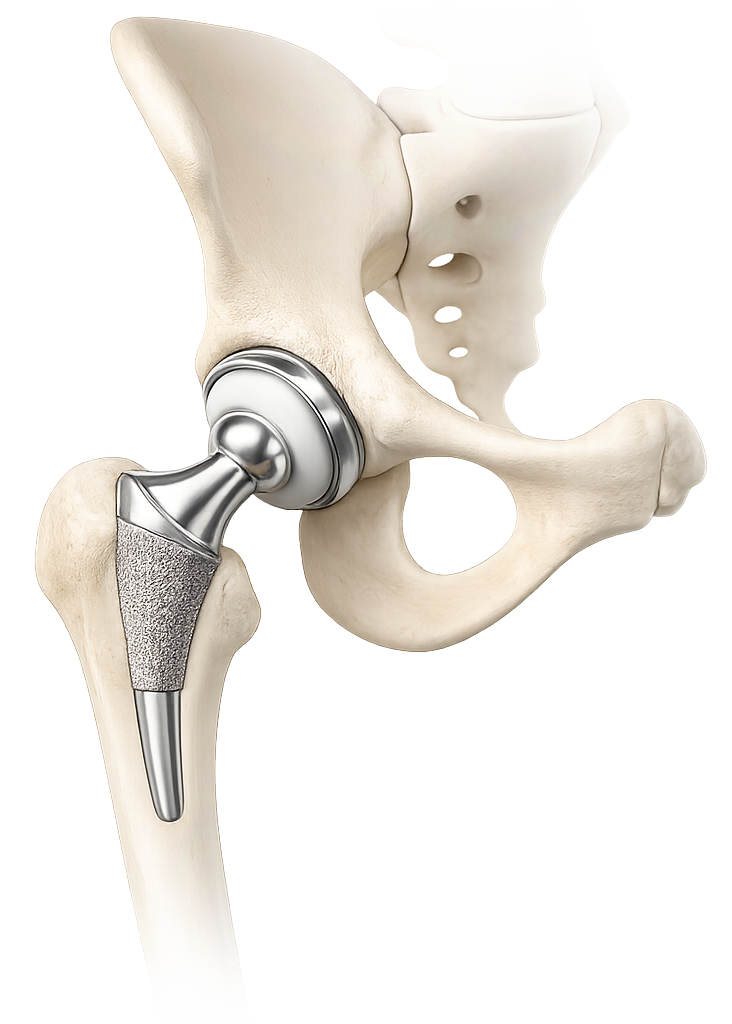
In a total hip replacement, the damaged ball-and-socket joint is replaced with a prosthetic implant. The procedure addresses the hip joint where the head of the thigh bone (femur) meets the pelvis. Hip replacement is considered for patients with advanced joint damage that causes persistent pain and limits movement.
In a knee replacement, the worn surfaces of the knee joint are replaced with implants that allow the joint to move smoothly again. The procedure may involve replacing the entire knee joint (total knee replacement) or only the affected portion (partial knee replacement), depending on the extent of the damage.
Hip and knee replacement surgery, also known as arthroplasty, involves removing the damaged surfaces of a joint and replacing them with prosthetic components designed to replicate natural joint function. The goal is to relieve pain, restore mobility, and improve quality of life.
MAKO uses 3D CT-based planning software to create a detailed model of each patient’s unique joint anatomy before surgery. This allows the surgeon to design a personalised surgical plan in advance, tailored to the individual, rather than a one-size-fits-all approach.
During surgery, the surgeon guides the MAKO robotic arm to remove damaged bone and cartilage. MAKO’s AccuStop™ technology provides physical resistance at the boundaries of the pre-planned area, helping to protect healthy bone and surrounding soft tissue. The surgeon remains fully in control at all times, MAKO does not operate independently or make decisions.
MAKO SmartRobotics™ is designed to support more accurate implant positioning based on each patient’s specific anatomy. The system also allows the surgeon to adjust the plan in real time during surgery if needed.
To understand what MAKO technology means for your specific procedure, speak to Dr Reddy at your consultation.
Dr Luren Reddy is a general orthopaedic surgeon with a broad scope of practice, from hands and feet to hips, knees, and the spine. Hip and knee replacement surgery, knee arthroscopy, and shoulder arthroscopy are among his areas of particular focus.
Dr Reddy believes in a patient-centred approach, taking time to understand each patient’s condition, explaining their options clearly, and making treatment decisions collaboratively. His practice is built on the principle that informed patients get better outcomes.
Qualifications & Affiliations
Hip and knee replacement procedures are performed at Life Entabeni Hospital, one of Durban’s leading private surgical facilities. The hospital is equipped with the MAKO SmartRobotics™ system, supporting Dr Reddy in delivering advanced joint replacement care to patients across KwaZulu-Natal.
Practice Contact Details
The most common cause is osteoarthritis, the gradual breakdown of joint cartilage over time. Other causes include rheumatoid arthritis, post-traumatic arthritis following injury, and avascular necrosis. A thorough assessment with an orthopaedic surgeon is the only way to determine whether surgery is appropriate for your specific condition.
No. Joint replacement is typically considered after conservative treatments, such as physiotherapy, pain management, and activity modification, have not provided adequate relief. The decision is always made on a case-by-case basis in consultation with your surgeon.
MAKO SmartRobotics™ is a robotic-arm assisted surgical system developed by Stryker. It uses 3D CT-based planning to create a personalised surgical plan and guides the surgeon during the procedure to support more precise implant placement. The surgeon is in control at all times, the system does not operate independently.
The best way to find out is to book a consultation with Dr Reddy. He will assess your symptoms, review your imaging, and discuss all available treatment options with you, surgical and non-surgical.
Dr Reddy performs hip and knee replacement surgery at Life Entabeni Hospital, 148 Mazisi Kunene Road, Berea, Durban.
Every so often it's worth pausing to say thank you.
Over the years, so many patients have taken a moment to share their experience with us, and it's something we genuinely don't take for granted.
Each review represents someone who trusted us at a time they were in pain, uncertain, or a little anxious about what lay ahead. That trust means more than you know.
To everyone who has taken the time to share their experience - thank you. If you'd like to add your review, we welcome it. 🙏
g.page/r/CT38udyZQDs9EAE/review ... See MoreSee Less
0 CommentsComment on Facebook
Haven't been to see us yet? You'll find our rooms at Entabeni Hospital - easy to find, and close to imaging and theatre if you ever need it.
If that niggle has been on your to-do list for a while, now's a good time to pop in.
Life Entabeni Hospital,
Suite 11, Medical Centre East,
148 Mazisi Kunene Road,
Berea,
Durban, 4001. ... See MoreSee Less
2 CommentsComment on Facebook
A reminder that our website is there for more than just contact details.
You'll find information on the conditions we treat, what to expect from consultations and procedures, and answers to the questions patients ask most often before their first visit.
If you've been considering booking, or just want to know more before you do, it's a good place to start.
lurenreddyorthopaedics.co.za/
Link in bio. ... See MoreSee Less
0 CommentsComment on Facebook
Cortisone injections come up often in consultations, and there's usually some uncertainty about what they actually do.
They're a strong anti-inflammatory, used to reduce pain and swelling in a specific joint or area - not a cure, and not a long-term fix on their own.
They can be genuinely useful for calming a flare-up, confirming a diagnosis, or bridging the gap while other treatment, like physiotherapy, takes effect.
What they won't do is repair damaged cartilage or reverse an underlying structural problem. Knowing the difference helps set the right expectations before treatment starts. ... See MoreSee Less
0 CommentsComment on Facebook
Are you following us yet?
This is where we'll be sharing recovery tips, injury prevention advice, common myths, and what actually happens behind the scenes of orthopaedic care.
If you haven't already, give our page a follow so you don't miss what's coming this month. ... See MoreSee Less
0 CommentsComment on Facebook
For an older adult, a fall isn't always "just a fall." It can be the first sign of an underlying issue, like reduced bone density, muscle weakness, or a balance problem worth addressing.
Hip fractures in particular can significantly affect independence, which is why prevention matters as much as treatment.
Simple things help: strength and balance exercises, a home free of trip hazards, and, where needed, a bone density check.
If a parent or grandparent has had a fall recently, even a minor one, it's worth taking seriously rather than brushing it off. ... See MoreSee Less
0 CommentsComment on Facebook
If your heel pain is worse with the very first steps in the morning, there's a good chance you're dealing with plantar fasciitis.
It's one of the most common causes of heel pain I see, and it's often brushed off for months before someone comes in.
Left untreated, it can become a long, frustrating cycle. Managed early with the right stretching, footwear, and load management, most people improve significantly.
If those first few steps have been dreaded for weeks rather than days, it's worth having it assessed. ... See MoreSee Less
0 CommentsComment on Facebook
I never take it personally when a patient wants a second opinion.
This is your body, your recovery, and your decision. A second opinion isn't a vote of no confidence, it's part of making an informed choice, especially before surgery.
Sometimes a second opinion confirms the original plan. Sometimes it opens up an option worth considering. Either way, the patient leaves more confident in the path forward.
If you're weighing up a big decision, don't feel like you need permission to ask more questions. ... See MoreSee Less
1 CommentsComment on Facebook
One of the trickiest parts of recovery isn't the injury itself. It's knowing when and how to start moving again.
Too cautious, and you lose strength and confidence you didn't need to lose.
Too eager, and you risk undoing weeks of progress in a single session.
A good return-to-exercise plan is gradual, specific to your injury, and guided by how your body responds, not by a date circled on a calendar.
If you're not sure where you are in that process, that's a conversation worth having before you lace up. ... See MoreSee Less
0 CommentsComment on Facebook